


Given a set of  sample points
 of an
unknown continuous function
of an
unknown continuous function  , we want to estimate the derivative
  of the function at an arbitrary point
  . In general, the sample points are not
assumed to be evenly spaced in the dimension of .
. In general, the sample points are not
assumed to be evenly spaced in the dimension of .
We first reconstruct a continuous function to fit a set of n+1 sample points around the
point for which the derivative  needs to be estimated by Lagrange interpolation:

 is a polynomial function of of order
  which passes through all n+1
sample points, i.e.,
which passes through all n+1
sample points, i.e.,
 . For example, when
  ,
we have
,
we have

 , we have
 |
|||
 |
 |
||
 |
 |
||
|
 |
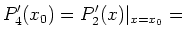
Now the derivative of function  at any point can be estimated by
differentiating . For example, when :
at any point can be estimated by
differentiating . For example, when :

 is the middle point of the set of
 points, we have
 , we have
 |
|||
|
 |
||
![$\displaystyle +(x-x_{-1})(x-x_1)(x-x_2)+(x-x_{-1})(x-x_0)(x-x_2)+(x-x_{-1})(x-x_0)(x-x_1) ]$](img95.png) |
|||
|
 |
||
![$\displaystyle +(x-x_{-2})(x-x_1)(x-x_2)+(x-x_{-2})(x-x_0)(x-x_2)+(x-x_{-2})(x-x_0)(x-x_1) ]$](img97.png) |
|||
|
 |
||
![$\displaystyle +(x-x_{-2})(x-x_1)(x-x_2)+(x-x_{-2})(x-x_{-1})(x-x_2)+(x-x_{-2})(x-x_{-1})(x-x_1) ]$](img99.png) |
|||
|
 |
||
![$\displaystyle +(x-x_{-2})(x-x_0)(x-x_2)+(x-x_{-2})(x-x_{-1})(x-x_2)+(x-x_{-2})(x-x_{-1})(x-x_0) ]$](img101.png) |
|||
|
 |
||
![$\displaystyle +(x-x_{-2})(x-x_0)(x-x_1)+(x-x_{-2})(x-x_{-1})(x-x_1)+(x-x_{-2})(x-x_{-1})(x-x_0) ]$](img103.png) |
,
 |
|||
|
 |
||
|
 |
||
|
 |
||
![$\displaystyle +(x_0-x_{-2})(x_0-x_1)(x_0-x_2)+(x_0-x_{-2})(x_0-x_{-1})(x_0-x_2)
+(x_0-x_{-2})(x_0-x_{-1})(x_0-x_1) ]$](img108.png) |
|||
|
 |
||
|
 |
In particular when  's are equally spaced, i.e.
 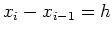 , the
estimated derivative at can be found to be
, the
estimated derivative at can be found to be

 . Here
  is
estimated using 3 points
is
estimated using 3 points
 and is therefore
called the forward estimation.
and is therefore
called the forward estimation.
We can also get backward estimation of using
 :
:

The average of the forward and backward estimations can be used as the final
estimation of .
To overcome possible noise, better estimation may be obtained by using more points, such as 4 or 5 points.
The four-point forward estimation:


The five-point forward estimation:


This method is based on the assumption that the function is
continuous and noise-free. If this is not the case, the estimation error
could be large.